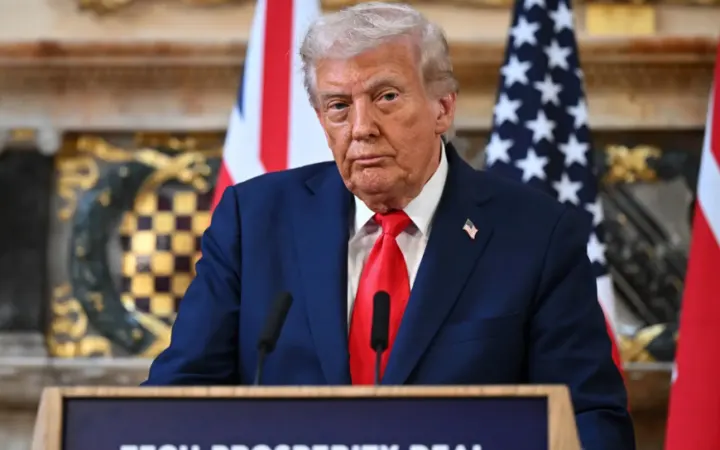
President Trump said in March 2025 that several of former President Joe Biden’s final pardons, including those for members of the House January 6 committee, are void because they were signed with an autopen. A 2005 Justice Department legal opinion found that a president may use an autopen to sign documents.
President Donald Trump is challenging a number of pardons issued by former President Joe Biden just before he left office. Trump says those pardons are not valid because they were signed using an autopen, a mechanical device that reproduces a signature.
In a late-night post on his Truth Social platform in March 2025, Trump wrote that the pardons Biden “gave to the Unselect Committee of Political Thugs, and many others, are hereby declared VOID, VACANT, AND OF NO FURTHER FORCE OR EFFECT,” because they were done by autopen.
The statement raised questions about whether a president can undo a predecessor’s pardons. A 2005 legal opinion from the Justice Department’s Office of Legal Counsel concluded that a president may use an autopen to sign a bill, and pardons signed this way have not previously been overturned. Trump and some conservative groups are now arguing otherwise.
Who Biden pardoned before leaving office
In his final weeks and hours in office, Biden issued a series of preemptive pardons that drew national attention. They covered members of his own family, members and staff of the House January 6 committee, and other public figures, including former Joint Chiefs Chairman Gen. Mark Milley and Dr. Anthony Fauci, who had not been charged with any crimes.
Republicans criticized the pardons, and some Democrats also questioned the decision to include Biden’s relatives.
Trump’s response after taking office
On his first day back in office, January 20, 2025, Trump pardoned or commuted the sentences of nearly 1,600 people charged in connection with the January 6 Capitol riot. Trump has long said those defendants were treated unfairly.
He has repeatedly criticized the January 6 committee, calling it the “Unselect Committee,” and has said some of its members, including former Representative Liz Cheney, should be prosecuted.
Debate over the autopen
White House Press Secretary Karoline Leavitt told reporters that the administration is questioning whether Biden personally authorized the pardons, since they were signed by autopen rather than by hand.
The conservative Heritage Foundation’s Oversight Project had earlier raised similar questions about Biden’s use of the autopen. Legal scholars have noted that the Constitution does not require a pardon to be in writing or signed in a specific way.
Biden’s explanation
When he pardoned members of his family on January 19, 2025, Biden said he acted out of concern that they would be targeted for political reasons.
“My family has been subjected to unrelenting attacks and threats, motivated solely by a desire to hurt me, the worst kind of partisan politics,” Biden said in a statement. “Unfortunately, I have no reason to believe these attacks will end.”
Why the pardons drew controversy
Preemptive pardons for people who have not been charged with a crime are rare, though not unprecedented. President Gerald Ford’s 1974 pardon of Richard Nixon is the best-known example.
What comes next
It is unclear what legal steps, if any, will be taken to challenge the pardons. Trump has said it would be up to a court to decide whether they remain valid.
Many legal experts say there is no established mechanism for a president to revoke a pardon that has already been granted. A court challenge could test how far presidential pardon power and the use of autopen signatures extend under the law.
Source: NBC News