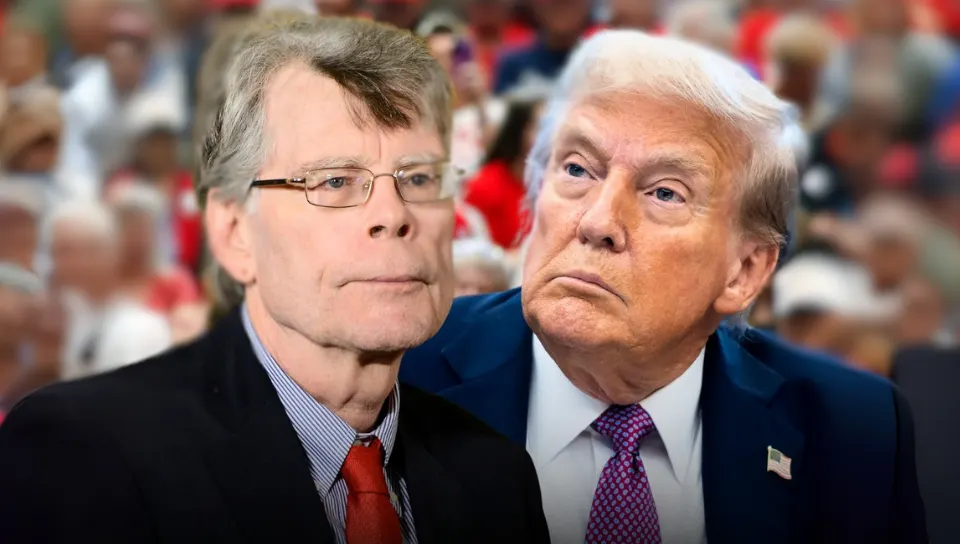
In a stark Stephen King Trump forecast, the horror author predicts that history books will label President Donald Trump a villain in the coming decades. King also believes many voters who once supported Trump will eventually deny they ever did.
Stephen King, the undisputed master of horror and one of America’s most influential authors, has penned a chilling new story, not in a novel, but in a stark prediction about the future of American politics. The prolific writer, who has become as famous for his sharp political commentary as for his terrifying literary creations, has forecasted a dark legacy for President Donald Trump. King predicts that in the coming decades, history books will unequivocally label Trump a **villain**. But the prophecy has a second, even more provocative twist: he believes that a significant portion of the electorate who once passionately supported him will eventually deny ever having done so. This haunting vision of a future America grappling with a form of collective political amnesia has ignited a firestorm of debate. It taps into a deep cultural anxiety about truth, memory, and the ultimate judgment of history. Is King simply indulging in wishful thinking, or is his finger so precisely on the pulse of the nation that he can see a future that is still invisible to the rest of us?
A horror author pens a real-life prophecy.
Will history judge a president harshly?
The Critic-in-Chief: The Long Stephen King Trump Feud
This latest prediction is no isolated outburst. Stephen King has been one of Donald Trump’s most prominent, relentless, and scathing critics for years. Their feud predates Trump’s presidency, but it escalated dramatically after the 2016 election. Through his powerful social media presence, particularly on X (formerly Twitter), King has waged a daily campaign against Trump’s policies and character. He has compared the former president to some of the most terrifying villains from his own novels, including the menacing clown Pennywise from “It” and the tyrannical Randall Flagg from “The Stand.” King’s criticisms are not just generic political disagreements; they are deeply personal and often framed in the language of morality, sanity, and existential threat. He has called Trump “a horrible president,” “a demented man-child,” and a “danger to the country.” This long and public history of animosity culminated in Trump blocking King on social media, a move the author wore as a badge of honor. King’s **opposition** is not just that of a concerned citizen; it’s the visceral reaction of a storyteller who sees a real-life villain and feels compelled to write him into the ground.
He’s compared him to his most famous monsters.
Do you know the history of their epic Twitter feud?
The Verdict of History: How Legacies are Made (and Unmade)
Stephen King’s prediction touches on a fascinating and often brutal process: the way history judges its most powerful figures. A leader’s reputation is rarely fixed at the moment they leave office. Instead, it is a fluid and constantly evolving narrative shaped by future generations of historians, artists, and the public. What is celebrated in one era can be condemned in the next. Think of historical figures whose reputations have undergone dramatic reassessments over time. King’s prediction posits that Trump’s presidency will be one such case. He is betting that the controversies, the divisive rhetoric, and the challenges to democratic norms that have defined the Trump era will look even more damning with the passage of time. The argument is that once the immediate political passions have cooled, a clearer, more objective consensus will emerge, and that consensus will not be kind. This process of historical **judgment** is not about politics; it’s about the long-term evaluation of a leader’s impact on their nation and the world. King is essentially arguing that Trump’s legacy will be a cautionary tale, a story told to future generations about the fragility of democracy.
The past is never truly past.
How does history cast its final judgment?
“I Never Supported Him”: The Psychology of Political Denial
The most provocative part of Stephen King’s prediction is the idea that Trump’s supporters will one day deny their allegiance. This concept, while sounding like fiction, has roots in real psychological and historical phenomena. When a leader or a movement becomes widely discredited, it is not uncommon for former adherents to distance themselves, either consciously or subconsciously. This “political amnesia” can be a coping mechanism, a way to protect one’s self-image from the social stigma of having supported a failed or villainized cause. It allows individuals to align themselves with the new prevailing consensus without having to confront their past beliefs. History is filled with examples of populations that, after the fall of a tyrannical regime, claim they “never knew” the extent of the horrors or were “secretly opposed” all along. King’s prediction suggests that the **MAGA** hat will one day become a symbol that people are not proud of, and that bumper stickers will be quietly scraped off. It’s a deeply cynical take on human nature, but one that implies a future where the **moral** arc of the universe, as the saying goes, has bent toward a different kind of justice.
“Trump? Never heard of him.”
Can you imagine a world where people deny their past support?
The Reaction: Fire and Fury from Both Sides
As expected, Stephen King’s prophecy was met with a deeply polarized reaction. On one side, critics of President Trump hailed the author as a modern-day Nostradamus. They embraced his prediction as a comforting and validating vision of the future, a sign that sanity and historical justice would ultimately prevail. Social media was flooded with messages of agreement, with users sharing the prediction and adding their own hopes that it would come true. They see it as an inevitable outcome for a presidency they view as chaotic and damaging. On the other side, Trump’s supporters reacted with fury and ridicule. They dismissed King as an “out-of-touch liberal elite” and a “Hollywood leftist” who is fundamentally disconnected from the values of “real Americans.” They accused him of arrogance and elitism for presuming to know how history will judge their movement. For them, King is just another voice in a media landscape they believe is biased against them, and his prediction is seen not as a prophecy, but as a partisan attack and a desperate form of **wish-casting**. The backlash was fierce, demonstrating that the battle over Trump’s legacy is not something that will be waged in the distant future; it is being fought, with incredible passion, right now.
The internet is divided, as always.
Nostradamus or out of touch?
The Storyteller as Prophet: Why King’s Voice Matters
Why does a prediction from a horror novelist carry so much weight? The answer lies in Stephen King’s unique position in American culture. He is more than just a bestselling author; he is a master observer of the American psyche, particularly its darker corners. His stories often tap into the anxieties, fears, and moral failings that lie just beneath the surface of everyday life. From the small-town bigotry in “It” to the corrupting influence of power in “The Dead Zone,” his fiction has always been deeply political, exploring how ordinary people react under extraordinary pressure. His fans, who number in the hundreds of millions, don’t just read his books for scares; they read them for his profound insights into human nature. When he speaks about politics, he does so with the authority of a storyteller who has spent fifty years chronicling the battles between good and evil, sanity and madness, in the American soul. His voice resonates because he is not seen as a typical political pundit. He is seen as a **diagnostician** of the nation’s character, and his Trump prediction is his most terrifying **diagnosis** yet.
He writes about more than just monsters.
What gives his political voice so much power?
Trump’s Own View of His Legacy
Of course, President Trump himself has a vastly different view of how he will be remembered. He has often spoken of his presidency in historic, and even unprecedented, terms. He frequently boasts about his accomplishments, such as the economy during his first term, his appointments of conservative judges, and his “America First” foreign policy. He sees himself not as a villain, but as a revolutionary figure, a champion of the “forgotten man and woman” who bravely took on a corrupt establishment. His supporters share this view, seeing him as a strong leader who fights for them against a hostile world. From his perspective, the negative coverage from the “mainstream media” and the criticisms from figures like Stephen King are not legitimate critiques but are part of a coordinated “witch hunt” designed to undermine his success. Trump is actively engaged in crafting his own legacy in real-time, through rallies, social media, and his own powerful brand of storytelling. He is betting that his version of the story, the one of a triumphant hero battling deep-state villains, will be the one that **endures**, regardless of what his critics write in their history **books**.
He’s writing his own history book.
How does the President see his own place in history?
Is It Just Wishful Thinking?
For those who oppose President Trump, Stephen King’s prediction is a beacon of hope. It suggests that the current political reality is a temporary madness, an aberration that will eventually be corrected by the sober judgment of history. However, it is also important to consider the alternative: that King is wrong. History is famously written by the victors, and the battle for the narrative of the Trump era is far from over. Trump’s movement has proven to be incredibly resilient, and his bond with his supporters is exceptionally strong. It is entirely possible that, in 30 years, his presidency will be viewed by a large segment of the population not as a failure, but as a heroic last stand for a certain vision of America. In this scenario, his supporters would not deny their allegiance; they would celebrate it. The history books themselves might become a battleground, with competing versions of the Trump presidency taught in different parts of the country. King’s prediction is a powerful one, but it is not a **guarantee**. It is one possible future in a deeply divided nation where the two sides can no longer even agree on the basic facts of the **present**.
Could the King of Horror be wrong?
The battle for the history books is just beginning.
A Nation of Narratives
Ultimately, the Stephen King vs. Donald Trump feud over his legacy is a perfect metaphor for the current state of America. It is a nation of competing narratives, where two sides can look at the exact same set of events and see polar opposite realities. One side sees a villain whose actions have stained the nation’s character; the other sees a hero who is fighting to save it. The battle is not just about policy or politics; it’s about the story America tells about itself. Stephen King, a master storyteller, has offered his version of the final chapter. He believes that the narrative of Trump as a villain will eventually become the dominant one, so powerful that people will be ashamed to have been part of the original story. President Trump, a master marketer and narrator in his own right, is crafting a powerful counter-narrative of heroism and persecution. The question of who will be remembered as the hero and who will be the villain is not just an academic debate. The answer will define the **character** of the nation for generations to **come**.
A tale of two Americas.
Which story will become our history?
Conclusion: The Final Chapter is Unwritten
In the end, only time will tell if Stephen King’s chilling prophecy comes to pass. Will future generations read about the Trump presidency in horror, as King suggests, or will they see him as the heroic figure he purports to be? Will his supporters stand by their choice, or will a great political forgetting sweep the nation? King has written a potential ending, but the final chapter of this American story remains unwritten. The characters, the politicians, the voters, and the storytellers themselves, are still deciding what the ultimate moral of the story will be. For now, we are all living inside a Stephen King narrative, and like all of his best work, nobody knows for sure how it’s going to **end**.