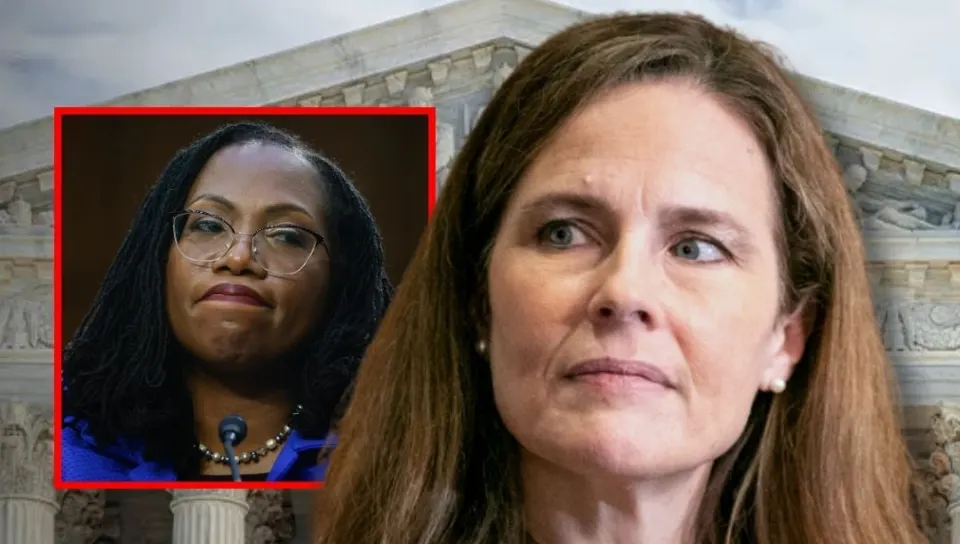
Justice Amy Coney Barrett publicly defended the sharp tone of her majority opinion in the universal injunctions case, which was widely seen as a rebuke of Justice Ketanji Brown Jackson. Barrett said the comments were warranted and, quoting the late Justice Antonin Scalia, said she attacks ideas, not people.
In a rare public comment, Supreme Court Justice Amy Coney Barrett defended the sharp tone she took toward her colleague Justice Ketanji Brown Jackson in a majority opinion on “universal injunctions.” In a Fox News interview in September 2025, Barrett described the passage as warranted, said she tends “not to be spicy for the sake of being spicy,” and repeated a line she credited to the late Justice Antonin Scalia: “I attack ideas. I don’t attack people.”
The remarks drew new attention to a sharp exchange between the two justices in one of the most closely watched decisions of the Supreme Court’s term, a ruling on how far federal judges can go in blocking government policies nationwide.
What is a ‘Universal Injunction’? The Issue at the Heart of the Dispute
A universal injunction, also called a nationwide injunction, is an order by a single federal district judge that blocks a government policy for everyone in the country, not only for the people or groups that brought the lawsuit.
Supporters say these orders are an important check on executive power because they can stop a potentially unlawful policy quickly. Critics say they allow one judge out of hundreds to set national policy and encourage litigants to file in courts they expect to be friendly. Judges appointed by presidents of both parties have issued such orders, blocking policies of the Trump administration in its first and second terms and of the Biden administration.
The Barrett Opinion
The dispute came in Trump v. CASA, decided on June 27, 2025. The case grew out of lawsuits over President Donald Trump’s executive order restricting birthright citizenship. By a 6-3 vote, the Court ruled that universal injunctions likely exceed the authority Congress has given federal courts, and it limited the lower-court orders to what was needed to give relief to the plaintiffs. The Court did not decide whether the executive order itself is constitutional.
Barrett wrote the majority opinion. She argued that universal injunctions have no basis in the historical powers of courts of equity. She also responded directly to Jackson’s separate dissent, writing that “Justice Jackson decries an imperial Executive while embracing an imperial Judiciary.”
The Dissent: Jackson’s Defense of Broad Court Orders
Justice Sonia Sotomayor wrote the principal dissent, joined by Justices Elena Kagan and Jackson. Jackson also wrote her own dissent, arguing that allowing the government to apply a policy that courts have found likely unconstitutional to anyone who has not yet sued is a serious threat to the rule of law. She argued that the ruling would let rights depend on whether a person had gone to court.
“I Attack Ideas, Not People”
In her public comments, Barrett drew a line between disagreement over legal reasoning and personal criticism. Her view is that legal arguments in opinions should be able to withstand forceful scrutiny. Some court observers have said that pointed language between justices risks damaging the Court’s image of collegiality, while others say vigorous written debate is a normal part of the Court’s work.
A Long-Running Debate on the Court
The debate over universal injunctions did not begin with this case. Justices Neil Gorsuch and Clarence Thomas had criticized the practice in earlier opinions, and the number of nationwide orders grew sharply over the past several administrations. The CASA decision was the Court’s most direct ruling on the issue.
Real-World Consequences
The ruling makes it harder for a single judge to block a new federal policy for the whole country. Challengers can still seek relief through other routes, such as class action lawsuits or suits brought by states, and several lower courts have since considered such cases involving the birthright citizenship order.
Collegiality on the Court
Justices have often spoken about their friendships across ideological lines, such as the well-known friendship between the late Justices Ruth Bader Ginsburg and Antonin Scalia. Barrett’s comments suggest she sees sharp written disagreement as compatible with that tradition.
Sources: Fox News, "Justice Barrett defends Jackson jabs as 'warranted' in rare public appearance" (September 4, 2025)
Correction, October 25, 2026: Justice Barrett wrote the majority opinion, not a concurring opinion, and she said she tends "not to be spicy for the sake of being spicy." She credited the line "I attack ideas. I don't attack people" to the late Justice Antonin Scalia.