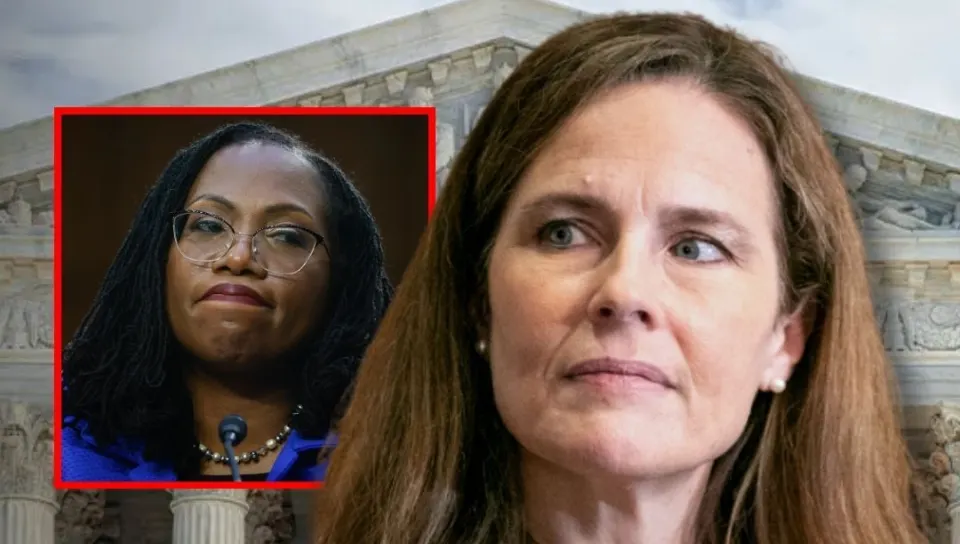
Barrett spicy remarks drew new attention when Justice Amy Coney Barrett publicly defended the sharp tone of an opinion widely seen as a rebuke of Justice Ketanji Brown Jackson over universal injunctions. Barrett said the comments were warranted and that she attacks ideas, not people.
In a rare and candid public comment, Supreme Court Justice Amy Coney Barrett defended the sharp tone she took in a recent opinion, which was widely seen as a direct and forceful rebuke of her colleague, Justice Ketanji Brown Jackson. Acknowledging her remarks on the contentious legal issue of “universal injunctions” were “spicy,” Barrett insisted they were “warranted” and clarified her judicial philosophy by stating, “I attack ideas. I don’t attack people.” The exchange has pulled back the curtain on the intense intellectual battles raging within the nation’s highest court, particularly over the power of federal judges. The clash occurred within the context of a case concerning a sweeping lower court order that halted a major government policy nationwide. Barrett’s sternly worded concurring opinion, which took aim at the legal reasoning championed in Jackson’s dissent, has ignited a firestorm of debate among court watchers about the evolving norms of civility and the sharpening of ideological lines on the increasingly polarized bench.
A rare public clash rocks the Supreme Court!
Do you understand the core of this judicial showdown?
Only the most observant will pass this first test!
What is a ‘Universal Injunction’? The Issue at the Heart of the Dispute
To understand the fiery exchange, one must first understand the legal mechanism at its center: the universal injunction. Also known as a nationwide injunction, it is a powerful and controversial tool where a single federal district judge can issue an order that blocks the enforcement of a government policy or law across the entire country, not just for the specific parties involved in the lawsuit. For example, if a new immigration policy is enacted, a judge in California could block it from taking effect anywhere in the nation. Proponents of this power, often including those in the Court’s liberal wing, argue that it is a crucial check on executive overreach, allowing one court to quickly stop a potentially illegal and harmful policy before it can be implemented nationwide. Opponents, typically conservatives on the bench, argue that it amounts to “government by a single judge,” creating chaos and allowing one court out of hundreds to set policy for the entire country. They contend it short-circuits the normal judicial process, where different courts can weigh in on an issue before it reaches the Supreme Court. This fundamental disagreement over the proper scope of judicial power is the tinderbox that ignited the “spicy” exchange.
One judge to rule them all?
Do you grasp the immense power of a “universal injunction?”
The Barrett Spicy Remarks: Her Intellectual Attack
In the case at hand, the Supreme Court’s majority voted to lift a universal injunction that had been imposed by a lower court. Justice Barrett joined that majority but wrote a separate concurring opinion to launch a detailed and blistering critique of the legal reasoning that supports such injunctions. While she did not name Justice Jackson directly in this section, her arguments were a clear and systematic dismantling of the points raised in Jackson’s dissent. Barrett argued that there is no historical basis for this kind of judicial power and that it has created an “untenable” situation where litigants “shop” for a sympathetic judge to block policies they dislike. Her tone was academic but sharp, methodically picking apart the counterarguments and labeling them as historically unsound and practically unworkable. It was this incisive and unapologetic critique that she later referred to as “spicy.” By writing separately, she was able to express her views more forcefully than the main majority opinion, signaling her strong stance on the issue and framing the debate in stark, intellectual terms.
Here comes the spice!
Can you break down the key points of Justice Barrett’s sharp-tongued opinion?
Pay close attention to the details of her legal reasoning!
The Dissent: Jackson’s Forceful Defense of Judicial Power
On the other side of the intellectual battlefield was Justice Ketanji Brown Jackson. In her dissenting opinion, she argued passionately for the necessity of universal injunctions as a tool to protect citizens from unlawful government action. She contended that when a government policy is found to be illegal, it should be stopped everywhere, not just in one small geographic area. To do otherwise, she suggested, would create a chaotic patchwork of laws where a citizen’s rights depend on where they happen to live. Her dissent framed the issue as one of access to justice, arguing that without the ability for a single court to provide broad relief, many people harmed by an illegal policy would have no practical way to challenge it. She warned that stripping courts of this power would effectively give the executive branch a green light to enact illegal policies, knowing that any legal challenges would be slow and limited in scope. It was this full-throated defense of judicial power as a protective shield for the public that drew the direct and “warranted” fire from Justice Barrett.
A shield for the people!
Can you articulate Justice Jackson’s passionate defense of broad court orders?
“I Attack Ideas, Not People”: A Defense of Judicial Debate
Justice Barrett’s subsequent public defense of her “spicy” tone is perhaps the most revealing part of the entire episode. By saying, “I attack ideas. I don’t attack people,” she was drawing a clear line between intellectual disagreement and personal animosity. In her view, the Supreme Court is a forum for rigorous, high-stakes debate, and the ideas presented in legal opinions must be able to withstand forceful scrutiny. This statement can be interpreted as a defense of a more traditional, perhaps old-fashioned, view of judicial debate, where sharp, pointed language is not only acceptable but necessary to test the strength of an argument. It suggests she believes that true respect among colleagues is shown not by avoiding conflict, but by engaging with each other’s ideas honestly and robustly, even if it leads to uncomfortable or “spicy” moments. However, critics might argue that in today’s hyper-partisan environment, the line between attacking an idea and attacking the person who holds it is easily blurred, and that such sharp language can undermine the Court’s appearance of collegiality and impartiality, making it look more like a political body than a judicial one.
“It’s not personal, it’s strictly business.”
What is the philosophy behind Justice Barrett’s controversial remarks?
A Sharpening Divide: Not Just an Issue for the Newcomers
While the exchange between the two newest justices has drawn headlines, the debate over universal injunctions is a long-simmering battle that involves the entire court. It is a key fault line in the broader war over judicial philosophy. For years, conservative justices like Neil Gorsuch and Clarence Thomas have written opinions railing against the practice, arguing that it has exploded in use in recent decades and is a dangerous departure from traditional legal norms. Justice Gorsuch, in particular, has called it a “rush to our court” that forces the Supreme Court to act like a “final court of review for virtually every important executive action.” Conversely, liberal justices like Sonia Sotomayor and Elena Kagan have, at times, defended the practice as a necessary safeguard, especially when policies affecting vulnerable populations like immigrants or minorities are at stake. The Barrett-Jackson clash is therefore not a new fight, but rather the latest and perhaps most pointed chapter in an ongoing ideological struggle. It signifies that the Court’s newest members have fully entered the fray and are now helping to define the terms of this critical debate.
This is an old war with new soldiers.
Can you place this recent clash in the larger context of the Court’s ideological battles?
Real-World Consequences: How This Debate Affects You
This seemingly academic debate among justices in black robes has profound real-world consequences that can affect every American. The use of universal injunctions has surged under the past several presidential administrations, becoming a primary tool for political opposition to halt the White House’s agenda. During the Trump administration, judges issued dozens of nationwide injunctions, blocking high-profile policies on immigration, transgender military service, and environmental regulations. During the Biden administration, the tables turned, and conservative-leaning judges issued their own universal injunctions to block policies related to vaccine mandates, student loan forgiveness, and climate initiatives. This legal whiplash creates uncertainty and instability, as policies are turned on and off by single judges, often with little warning. The outcome of the Supreme Court’s internal battle could determine whether this trend continues. If Justice Barrett’s view prevails and the Court significantly curtails the power of universal injunctions, it would become much harder to block a new presidential policy from taking effect. If Justice Jackson’s view holds, the power of a single judge to act as a swift, national check on the president will remain.
This isn’t just theory; it’s reality.
How does this high-level legal fight actually impact national policy?
Connect the dots between the Court’s debate and the headlines you see every day!
Collegiality in the Crosshairs: A Look at Court Dynamics
The Supreme Court has long prided itself on maintaining a sense of collegiality, even amidst sharp disagreements. The justices often speak of their friendships with colleagues on the opposite ideological side, famously exemplified by the close bond between the late Justices Ruth Bader Ginsburg and Antonin Scalia. This sense of mutual respect is seen as essential to the functioning of the Court, allowing for compromise and ensuring that legal debates don’t devolve into personal animosity. However, the increasingly pointed and public nature of disagreements, like the one between Barrett and Jackson, has led many to question if this tradition is eroding. As the issues before the Court become more aligned with the nation’s most divisive political battles, and as the confirmation process for new justices becomes more contentious, maintaining that collegiality is harder than ever. Justice Barrett’s defense of her “spicy” remarks suggests she believes the intellectual integrity of the debate is paramount, while critics fear that the cost of such “spice” might be the very collegiality that keeps the institution from fracturing under political pressure.
Can’t we all just get along?
Is the famous “collegiality” of the Supreme Court a thing of the past?
The Future of the Court: A New Era of Debate?
The Barrett-Jackson exchange may signal a new era for the Supreme Court, one defined by a more openly combative style of intellectual engagement. As the Court continues to tackle deeply divisive issues, from abortion and gun control to executive power and election law, the stakes for each decision are incredibly high. The philosophical gulf between the conservative and liberal wings appears wider than ever, leaving little room for middle ground. Justice Barrett’s “I attack ideas” philosophy may become the prevailing norm, where justices feel not only free but obligated to issue sharp, detailed critiques of their colleagues’ reasoning in the pages of the U.S. Reports. This could lead to clearer, more forceful articulations of different legal theories, but it could also further damage the public’s perception of the Court as a neutral arbiter of the law. The future of the Court may depend on whether the nine justices can find a way to wage a war of ideas without it becoming a war of personalities.
What does the future hold for the nation’s highest court?
Is this “spicy” exchange a sign of things to come?
Conclusion: Ideas, People, and the Health of a Democracy
Justice Barrett’s distinction between attacking ideas and attacking people is a foundational principle of healthy debate in a free society. Her willingness to engage robustly with a colleague’s legal reasoning is, in many ways, the essence of the judicial process. However, this high-profile clash serves as a powerful reminder that in an era of deep national division, the line between the idea and the person can become dangerously thin in the public’s eye. The “spicy” exchange over universal injunctions is about more than just legal theory; it’s about the health of our democratic institutions. Can the Supreme Court effectively function as the ultimate arbiter of law if its debates mirror the partisan rancor of the political branches? The answer will depend on the ability of all nine justices to navigate their profound ideological differences with a shared commitment to the institution they serve. The nation will be watching to see if the war over ideas leaves the Court stronger and its reasoning sharper, or if it inflicts wounds on the personal relationships and public trust essential for its long-term legitimacy.