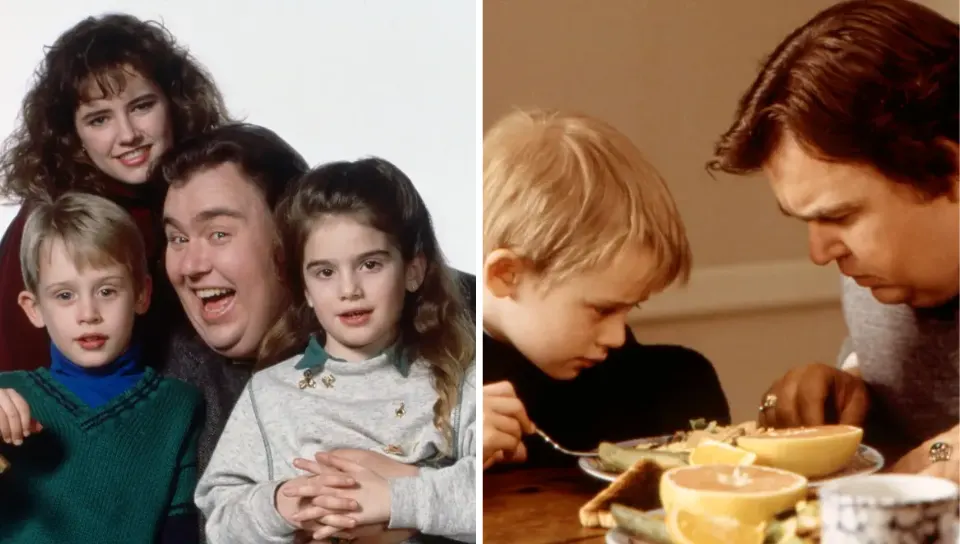
In the new John Candy documentary, John Candy: I Like Me, which premiered at the 2025 Toronto International Film Festival, Macaulay Culkin shares memories of his late co-star. Culkin, now 45, reveals that Candy offered gentle, paternal kindness during a period shaped by his difficult, controlling father.
For decades, Macaulay Culkin’s story has been a cautionary tale of child stardom, a narrative of immense fame, family turmoil, and a young life lived under the shadow of a difficult, controlling father. But a new documentary is pulling back the curtain on that painful period, revealing a quiet hero who offered a glimmer of kindness when it was needed most: the late, great John Candy. In the world-premiere screening of “John Candy: I Like Me” at the 2025 Toronto International Film Festival, Culkin, now 45, makes a rare and poignant appearance to share his memories of his legendary co-star. He reveals that long before the world knew the extent of his family’s troubles, Candy’s gentle and paternal instinct led him to be one of the very first people to notice that something was wrong at home. Culkin describes his father, Kit Culkin, as a “monster” even before the global phenomenon of “Home Alone,” and alleges his behavior only worsened with fame and money. Amid this brewing storm, it was the beloved star of “Uncle Buck” who, with quiet questions and genuine respect, provided a safe harbor for a young boy who felt he had none.
A painful secret is revealed decades later.
Who was the beloved comedy icon that noticed the truth?
The ‘Infamous Monster’: A Father’s Shadow
Macaulay Culkin does not mince words when describing his father, Kit Culkin, who managed his career during his meteoric rise to fame. The relationship, which has been estranged for decades, was allegedly fraught with emotional and physical abuse. In the documentary, Culkin paints a chilling picture of his childhood. “Listen, even before the wave crested and the Home Alone stuff was happening, it was not hard to see how difficult my father was,” he explains. “It was no secret. He was already a monster.” This baseline of difficult behavior allegedly escalated dramatically as his son became one of the most bankable stars in the world. “All of a sudden, the fame and the money came, and he became an infamous monster,” Culkin continues. “He was already not a good guy.” Both Macaulay and his actor brother, Kieran Culkin, have spoken in the past about their father’s controlling nature and the immense pressure he placed on them. Kit, a former actor himself who never achieved significant success, was said to be resentful and jealous of his son’s career. Macaulay has previously stated his father would say things like, “‘Do good or I’ll hit you,'” and made him sleep on the couch. This toxic environment was the backdrop of Macaulay’s childhood, a reality hidden behind the charming smile of Kevin McCallister that the whole world fell in love with.
A father’s jealousy cast a long, dark shadow.
How did fame and money make a bad situation even worse?
A ‘Paternal’ Presence: How Candy Showed He Cared
On the bustling and often impersonal set of a major Hollywood film, John Candy’s warmth and empathy stood in stark contrast to the harsh reality of Macaulay Culkin’s home life. Culkin recalls how Candy, who played his titular guardian in 1989’s “Uncle Buck,” seemed to effortlessly embody that protective role both on and off camera. He possessed an instinct, a quiet awareness, that allowed him to see past the facade of a celebrity child. “I think he always had that really great instinct,” Culkin says in the documentary. “I think John was looking a little side-eyed, like, ‘Is everything alright over there? You doing good? Good day? Everything’s alright? Everything good at home? Alright.’” These were not intense interrogations, but subtle, gentle check-ins from a man who genuinely seemed to care. Culkin describes Candy’s presence as “paternal” and notes that this kind of concern was a rarity. Most adults in his professional life were either oblivious or chose not to get involved. “I remember John caring when not a lot of people did,” Culkin states poignantly. This simple act of noticing, of asking if a child was okay, has clearly stayed with Culkin for over three decades, a testament to the profound impact that a moment of kindness can have on a person in a vulnerable situation.
He was watching with a “side-eyed” glance.
How did John Candy’s gentle actions speak volumes?
The John Candy Documentary on Respect for a Child Star
Beyond the quiet concern for his well-being, Macaulay Culkin also credits John Candy with being a uniquely gifted collaborator for a young actor. The world of child acting can be difficult, with many adult performers either unsure of how to interact with their young co-stars or simply annoyed by the challenges they can present. Culkin notes in the documentary that many actors “don’t know how or don’t like to work with kids” because they’re “tricky to work with.” But Candy was different. He approached their scenes together with a sense of play and, most importantly, with genuine respect. “John was always really kind, and really good with” him and his on-screen sibling, actress Gaby Hoffmann. “He showed a lot of respect. When you’re eight years old, you don’t really get respect, whether it’s in a workplace or just from adults and grown-ups in general. You felt invited in,” Culkin expressed. This feeling of being treated as an equal, a professional peer rather than a prop, is what makes Candy’s performance in “Uncle Buck” one of Culkin’s favorites. “I think that’s why that’s one of my favorite performances, because I think he put a lot of himself into it,” Culkin explained. Candy’s ability to connect with his young scene partners not only resulted in a more authentic and heartwarming film, but also left a lasting impression on a boy who was rarely afforded such dignity.
He treated an 8-year-old like a true professional.
Why was John Candy considered so special to work with?
‘John Candy: I Like Me’ – A Celebration of a Legacy
Macaulay Culkin’s powerful testimony is just one part of a larger, loving tribute to the Canadian comedy icon. The documentary, “John Candy: I Like Me,” which will stream on Prime Video starting October 10th, aims to provide a definitive and intimate portrait of the man behind the laughter. Directed by Colin Hanks (son of Tom Hanks) and executive produced by fellow Canadian star Ryan Reynolds, the film is packed with interviews from Candy’s closest friends and collaborators. Legends like Dan Aykroyd, Steve Martin, Martin Short, Catherine O’Hara, Eugene Levy, and Bill Murray all share their memories, painting a picture of a man who was as beloved off-screen as he was on. The film delves into Candy’s life and career, from his beginnings at Toronto’s famed Second City comedy troupe to his status as a global movie star. It also doesn’t shy away from his personal struggles, including his lifelong anxiety and the pressures of his weight, which were often cruelly linked to his comedic persona. The title itself comes from one of Candy’s most memorable lines in “Planes, Trains and Automobiles,” and serves as a guiding theme for the film, a reminder of Candy’s unique ability to find humor, heart, and self-worth in his characters. Culkin’s inclusion is particularly noteworthy, as he is known to be highly selective about the projects he participates in. His willingness to speak so openly is a clear indication of the profound and lasting impact John Candy had on his life.
A new film honors a comedy giant.
Do you know the key details behind the “John Candy: I Like Me” documentary?
The Man Behind the Laughs: Candy’s Own Demons
Part of what may have fueled John Candy’s extraordinary empathy was his own set of personal struggles, which the documentary explores with honesty and compassion. His life was shaped by a significant early trauma: his father, Sidney, died of a heart attack on John’s fifth birthday, an event that was reportedly never discussed within the family. This loss is believed to have contributed to a lifelong battle with anxiety. Friends and colleagues describe him as a man who often ate and drank his feelings, and smoked to quell his nerves. Near the end of his life, these anxieties manifested in more frequent and severe panic attacks. Candy also faced constant public and industry pressure about his weight. While his size was often part of his on-screen persona, he was subjected to cruel jokes and was told that his career depended on him remaining large. This created an impossible conflict for a man trying to get healthier. This undercurrent of sadness and anxiety, hidden behind one of the most joyful faces in comedy, likely gave him a unique sensitivity to the pain of others. Having known deep loss and insecurity himself, he was perhaps better equipped than most to recognize the signs of a child struggling under the weight of a difficult home life, and he knew the profound value of a simple, supportive gesture.
Behind the iconic smile was a man battling his own pain.
Did you know about the personal struggles that shaped John Candy?
A Lasting Impression: Decades Later
The fact that Macaulay Culkin is speaking out now, more than 30 years after John Candy’s death, highlights the incredible durability of that kindness. For a child navigating a toxic and high-pressure environment, a single, stable, and caring adult can become a crucial anchor. Culkin’s words make it clear that Candy’s impact was not fleeting. “It doesn’t happen that often. It actually happened less as time went on,” he says of the concern Candy showed. “I wish I got more of that in my life. It’s important that I remember that.” This statement is both a heartbreaking admission of the loneliness of his childhood and a powerful tribute to Candy’s character. It suggests that he has carried the memory of those gentle check-ins with him throughout his life, using them as a benchmark for decency. In 1995, at the age of 15, Culkin famously petitioned to have his parents removed as his legal guardians, effectively taking control of his own life and finances and formalizing his estrangement from his father. This was a young man who had to learn to protect himself at an early age, making the memory of an adult who offered that protection freely, with no strings attached, all the more precious.
The memory of kindness has not faded with time.
Why does Culkin’s tribute resonate so strongly three decades later?
A Tale of Two Co-Stars: The Films That Forged a Bond
The connection between Macaulay Culkin and John Candy was forged on the sets of two of the most iconic comedies of the era, both written or produced by the legendary John Hughes. Their first and most significant collaboration was 1989’s “Uncle Buck,” where Candy played a lovable, slobbish bachelor left in charge of his sharp-witted nephew (Culkin) and nieces. The film’s premise required a genuine chemistry between the two leads, and their on-screen rapport was palpable. It was during this production that Candy’s protective instincts first came to the forefront. The following year, they reunited for “Home Alone,” which would launch Culkin into the stratosphere of global superstardom. Though their screen time together was limited, Candy had a memorable cameo as Gus Polinski, the “Polka King of the Midwest” who gives Kevin’s desperate mother a ride to Chicago, the kindness continued. Kieran Culkin, Macaulay’s brother who had a small role in the film, recalled being starstruck by Candy in his trailer, remembering only that “he was really nice.” These films represent a pivotal moment in Culkin’s life, the calm before the full storm of “Home Alone” mania. It was in this window that John Candy’s decency made its mark, offering a model of adult behavior that was starkly different from what the young actor was experiencing off-camera.
polka king of the midwest
From bachelors to polka kings, test your 80s & 90s movie knowledge!
The Industry’s Blind Eye
Macaulay Culkin’s reflection that “not a lot of people did” care raises uncomfortable questions about the Hollywood system, particularly in the 1990s. Kit Culkin developed a reputation as one of the most difficult and demanding stage fathers in the business, notorious for making aggressive demands during contract negotiations and on set. His behavior was an open secret, yet the industry continued to work with him, eager to capitalize on his son’s immense box-office appeal. John Candy’s quiet concern was an exception to a general rule of non-interference. For many, the financial stakes were too high to risk angering the man who held the keys to the biggest child star in the world. This created an environment where a child’s well-being could be seen as secondary to the success of a film. Candy’s actions were not just those of a nice man; they were a quiet act of defiance against a culture that often looked the other way. He didn’t stage a grand intervention or go to the press. Instead, he simply offered human connection and let a troubled child know that he was seen. This subtle approach was perhaps the only one possible in a system that was, in many ways, enabling the very behavior he found so disturbing.
Kit Culkin’s reputation was an open secret in Hollywood.
Why did so many people choose to look the other way?
Conclusion: The Enduring Power of Kindness
John Candy passed away tragically from a heart attack in 1994 at the age of just 43, leaving behind a legacy of laughter and beloved film roles. But as the new documentary and Macaulay Culkin’s emotional recollections reveal, his true impact went far beyond the screen. In the high-pressure, often predatory world of Hollywood, Candy was a force of genuine warmth and decency. His ability to see the vulnerability in a young co-star and offer quiet support speaks volumes about his character. For Culkin, who emancipated from his parents at 15 and has been estranged from his father for much of his life, Candy’s kindness was a rare gift. “I wish I got more of that in my life,” he admits in the film. “It’s important that I remember that.” It is a powerful reminder that sometimes the smallest acts of empathy, a gentle question, a moment of respect, can be the very thing that helps a person endure an impossible situation. John Candy was a comedy legend, but for at least one little boy, he was also a much-needed glimpse of what a caring adult should be. His legacy is not just one of humor, but of profound humanity.