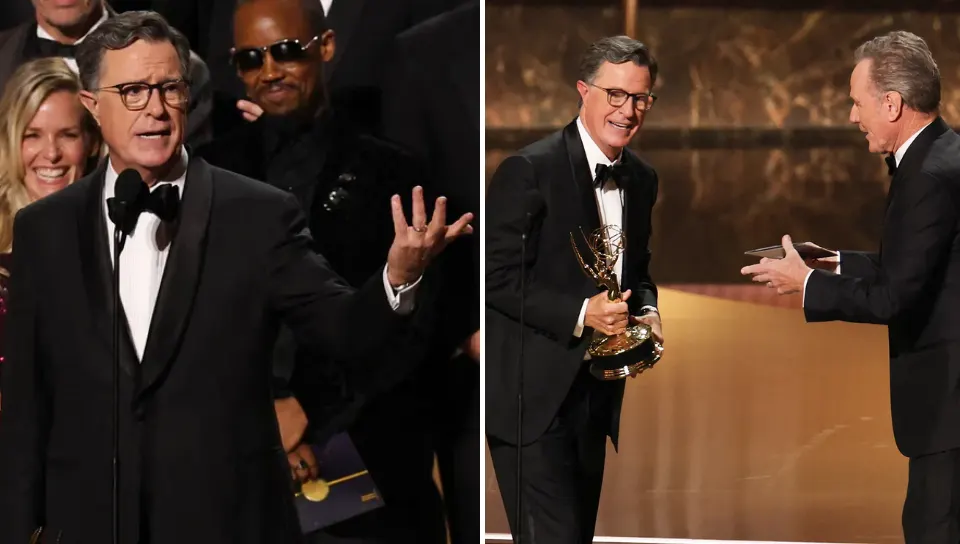
The Colbert Emmy for Outstanding Talk Series honored a late-night show its own network had already canceled, and the room gave Stephen Colbert a sustained standing ovation. Meanwhile, Greg Gutfeld, who consistently leads late-night ratings, received no such recognition.
In a moment that sent shockwaves through the television industry, Stephen Colbert, the recently dethroned king of late-night, stood on the Emmy stage accepting the award for Outstanding Talk Series for a show that had already been canceled. The room erupted in a sustained standing ovation, a mixture of celebratory defiance and somber acknowledgment. It was a stunning, almost surreal scene: the academy crowning a show that its own network had deemed financially unviable. Meanwhile, miles away from the glitz of Hollywood, another late-night host was likely preparing for his show. Greg Gutfeld, the undisputed ratings champion who consistently dominates not only Colbert but all of his network competitors, was, as usual, not in attendance. He wasn’t nominated. This single evening perfectly encapsulated the biggest debate in modern media: what matters more? Critical acclaim and industry respect, or the overwhelming voice of the viewing public? The clash between Colbert’s Emmy and Gutfeld’s ratings isn’t just a story about two comedians; it’s a battle for the very definition of influence in a deeply fractured America, forcing us to ask a difficult question: is the industry awarding talent, or just politics?
An award for a canceled show, a ratings king ignored.
A Bittersweet Colbert Emmy Victory Lap
“Well… this is awkward,” Colbert began, clutching the golden statuette as the applause finally began to fade. The line was classic Colbert: dry, self-aware, and perfectly timed. He went on to graciously thank his writers, his crew, and his family, but the most poignant moment came when he turned his attention to the network that had axed his show. “And I have to thank CBS,” he said with a wry smile. “They say if the elevator tries to bring you down, go crazy and punch a higher floor. So, thank you.” It was a masterclass in handling a difficult situation with humor and grace. The win was historic for *The Late Show*, which, despite numerous nominations, had never secured the top prize. For years, Colbert was seen as the intellectual, witty conscience of late-night, a darling of critics who dissected the political landscape with a satirist’s scalpel. His show was a place for deep conversations, sharp monologues, and a consistent, left-leaning critique of the powers that be. Yet, in a brutal industry calculation, critical acclaim and a loyal, albeit smaller, audience couldn’t save the show from the chopping block, with the network citing purely financial reasons. This Emmy felt less like a celebration and more like a validationa final, defiant statement from the creative community that quality television should be honored, even if it doesn’t always top the ratings charts.
The ratings king sits on a throne of viewership.
But why is his throne room empty of awards?
The Uncrowned King of Late Night
The irony of the Emmy celebration is cast in sharp relief by the staggering success of Greg Gutfeld. For months, even years, the Fox News host has been the undeniable ratings king. His show, *Gutfeld!*, which airs at 10 p.m. ET, regularly pulls in more viewers than Colbert, Kimmel, and Fallon. In some metrics, he has more viewers than his network competitors combined. His success is built on a formula that completely rejects the traditional late-night model. Instead of celebrity interviews and polished monologues, Gutfeld hosts a freewheeling panel discussion, cracking jokes and offering a scathing, conservative-libertarian critique of the daily news. His humor is aimed squarely at an audience that feels ignored or mocked by what they see as the liberal establishment of Hollywood. He is provocative, often controversial, and unapologetically partisan. To his millions of fans, he is a comedic hero speaking truth to power. To his detractors, he is a purveyor of low-brow, predictable talking points. But no one can argue with the numbers. He has built a ratings juggernaut. Yet, for all this success, he remains a ghost at the awards ceremonies. The television academy, the body that votes on the Emmys, has consistently and completely ignored him, a snub so total that it can no longer be seen as an oversight, but as a deliberate choice.
The golden statue is revered, but who decides the winner?
Do you know how the Emmy voting process actually works?
A Tale of Two Americas
The disconnect between the industry’s choice and the public’s preference highlights the deep cultural and political chasm in America. Stephen Colbert and Greg Gutfeld are not just two entertainers; they are avatars for two different Americas. Colbert represents a brand of intellectual, coastal, and progressive liberalism. His humor is built on a shared set of assumptions with his audience: that certain political figures are worthy of ridicule, that certain policies are self-evidently absurd, and that they are all in on the same sophisticated joke. His audience is the one that reads *The New York Times*, listens to NPR, and sees Hollywood as a cultural beacon. Gutfeld, on the other hand, is the champion of the “silent majority” that feels left behind by that very culture. His show is a safe space for those who are tired of being lectured by celebrities, who believe the mainstream media is biased, and who enjoy a more combative, less politically correct style of humor. He is a product of talk radio and the conservative blogosphere, and his success is a testament to the power of that underserved market. The Emmy voters, overwhelmingly comprised of industry insiders who live and work in the world Colbert satirizes, are naturally more attuned to his frequency. To them, Gutfeld’s show may not even register as “comedy” in the same vein. This isn’t necessarily a conscious conspiracy; it’s a reflection of a media world that has become incredibly siloed, where one half of the country has very little understanding or appreciation for what the other half finds entertaining.
Nielsen ratings are just one piece of the puzzle.
Where does the battle for influence take place online?
Beyond Nielsen: The Digital Divide
While Gutfeld is the undisputed king of cable ratings, the story of influence in 2025 is far more complex than traditional television viewership. In the digital arena, the roles are completely reversed. *The Late Show with Stephen Colbert* maintains a colossal online presence. The show’s YouTube channel has over 10 million subscribers, and clips of Colbert’s opening monologues regularly rack up millions of views, sometimes within hours of airing. In comparison, clips from *Gutfeld!* on the Fox News YouTube channel typically garner a fraction of that audience, often averaging around 500,000 views. This pattern repeats across every major social media platform, from Facebook to Instagram to TikTok, where Colbert’s show has a vastly larger and more engaged following. This data reveals a crucial distinction between the two audiences. Gutfeld’s viewers are a dedicated, appointment-viewing broadcast audience. They tune in at 10 p.m., watch the show, and that’s the extent of their engagement. Colbert’s audience is younger, more digitally native, and consumes his content in a completely different way. They watch clips on their phones, share memes on social media, and create a cultural conversation that extends far beyond the 11:35 p.m. time slot. For a network executive, this presents a complicated picture. Gutfeld delivers a large, reliable, but largely self-contained audience. Colbert delivers a smaller broadcast audience, but one that creates a much larger and more viral cultural footprint. The Emmy voters, being part of this digital conversation, are far more likely to see and be influenced by Colbert’s viral moments than Gutfeld’s broadcast ratings, further explaining the disparity in recognition.
Why would a network cancel an Emmy-winning show?
Is it always just about the money?
Prestige vs. Profit: The Network’s Dilemma
The Emmy win for a canceled show is the ultimate symbol of the eternal conflict in television: prestige versus profit. For any network, the ideal show is one that delivers both, a ratings hit that also wins awards and generates positive buzz. But in today’s fragmented media landscape, that’s an increasingly rare combination. Networks are often forced to choose. A show like *Gutfeld!* is a profit machine. Its production costs are relatively low, and its massive, loyal audience makes it a cash cow, attracting advertisers who want to reach that specific demographic. It may not win any awards, but it keeps the lights on and makes shareholders happy. A show like Colbert’s, on the other hand, is a prestige play. While its ratings were respectable, the high costs of production and Colbert’s hefty salary made it a much more expensive endeavor. Its value to the network was less about direct profit and more about branding. Winning Emmys, attracting A-list guests, and being part of the national “conversation” makes a network look good. It helps position them as a home for quality, which can attract other high-profile talent to the network. The decision by CBS to cancel *The Late Show* was a clear signal that, in the current economic climate, the balance has shifted. The cold, hard math of the bottom line ultimately outweighed the intangible value of cultural prestige. The Emmy serves as a final, ironic epitaph for a show that the industry loved but the accountants could no longer justify.
Two hosts, two audiences, two different definitions of success.
Are they just comedians, or symbols of a divided nation?
The Audience Has Spoken… But Which One?
Ultimately, the debate over Colbert’s award and Gutfeld’s ratings comes down to a simple question: which audience matters more? The answer in 2025 is that there is no single audience anymore. The era of three networks and a shared national culture is long gone. We now live in a world of infinite choice, where content is tailored to ever-more-specific niches. Greg Gutfeld has masterfully captured a massive niche that the rest of the entertainment industry either didn’t see or didn’t care to serve. He proved that there is a huge appetite for a late-night show that doesn’t talk down to conservatives. His success is a market correction, a powerful demonstration of consumer demand. Stephen Colbert, on the other hand, catered to a different, but equally valid, audience. His viewers sought a certain kind of intellectual rigor and satirical wit. They valued his thoughtful interviews and his intricate takedowns of political hypocrisy. His Emmy win is a declaration from that audience’s proxies in the industry that his work had artistic merit, regardless of its mass-market appeal. It’s entirely possible for both things to be true at once: Gutfeld is the most popular late-night host in America, and Stephen Colbert produced the best show. These are no longer mutually exclusive concepts. The Emmy result wasn’t a mistake; it was a choice to reward one form of success over another, a choice that reveals the deep-seated values of the institution making it.
So, talent or politics?
Can we weigh the different factors at play?
The Politics of Funny
It is impossible to ignore the role of raw politics in this entire affair. Late-night comedy, once a more general and unifying cultural force under hosts like Johnny Carson, has become another battlefield in the culture wars. Stephen Colbert’s comedy is inextricably linked to his progressive worldview. His jokes are designed to rally his side and ridicule the opposition. Similarly, Greg Gutfeld’s entire brand is built on being a conservative comedian in a liberal industry. His humor is a form of political combat. In such a polarized environment, it is naive to think that an awards body comprised of creative professionals, a group that is, by and large, overwhelmingly liberal, could judge a show like *Gutfeld!* on its comedic merits alone. For many voters, Gutfeld’s politics are not just a point of disagreement; they are an anathema to their own values. His jokes may land with millions of viewers, but in the jury rooms of the television academy, they are likely to be met with stony silence or outright hostility. Colbert’s win is, in this light, a political statement. It is the industry rewarding one of its own, a host who speaks their language and affirms their worldview. Gutfeld’s snub is the flip side of that coin: a refusal to legitimize a voice that they find distasteful. The Emmy is not just an award for television excellence; it has become a tool for cultural and political gatekeeping.
The industry is changing, but are the awards keeping up?
What does this moment mean for the future of television?
A Barometer of a Divided Nation
What happened at the 2025 Emmys was more than just an industry quirk; it was a perfect snapshot of a nation talking past itself. The image of the Hollywood elite giving a standing ovation to a canceled show, while completely ignoring the most-watched show in the genre, is a powerful symbol of the disconnect between our cultural institutions and a large portion of the populace. For supporters of Gutfeld, this is irrefutable proof of a biased, out-of-touch establishment that would rather reward a failure they agree with than acknowledge a success they despise. For supporters of Colbert, it’s a principled stand for quality and intelligence in an era of what they see as populist pandering. Both views have their own internal logic, and both are completely impenetrable to the other side. This isn’t just a debate about a TV show; it’s a proxy war for the soul of America. We can’t agree on who the President should be, we can’t agree on basic facts, and now, we can’t even agree on what’s funny. The Emmy for *The Late Show* and the ratings for *Gutfeld!* are two different answers to the same question: who gets to define American culture? The problem is, there is no longer a single, unified answer.
One gets the gold, the other gets the audience.
So, what does it all mean in the end?
Conclusion: An Award, A Rating, and an Unanswered Question
So, which has the bigger influence, talent or politics? The story of Stephen Colbert’s Emmy and Greg Gutfeld’s ratings dominance proves that the question itself may be obsolete. It’s no longer a simple binary choice. Influence is now a multi-faceted concept, measured in TV ratings, but also in YouTube views, social media engagement, and the ability to drive a conversation. Talent is subjective, judged through the lens of one’s own cultural and political biases. And politics is no longer a subtext in entertainment; it is often the main text. Colbert’s Emmy is a testament to the enduring power of the industry to recognize and reward the work it deems artistically valuable. Gutfeld’s ratings are a testament to the power of the audience to choose what it finds relevant and entertaining. One has the gold, the other has the crowd. In a divided America, perhaps that is the only kind of balance we can expect. There is no longer a single winner in the game of late-night television; there are only different champions for different tribes, each with its own valid, yet completely separate, claim to the throne.
The credits roll, but the debate is far from over.
You’ve reached the end! How did you score on the final test?
This is your last chance to prove you’re a media mastermind!
Source: NBC News