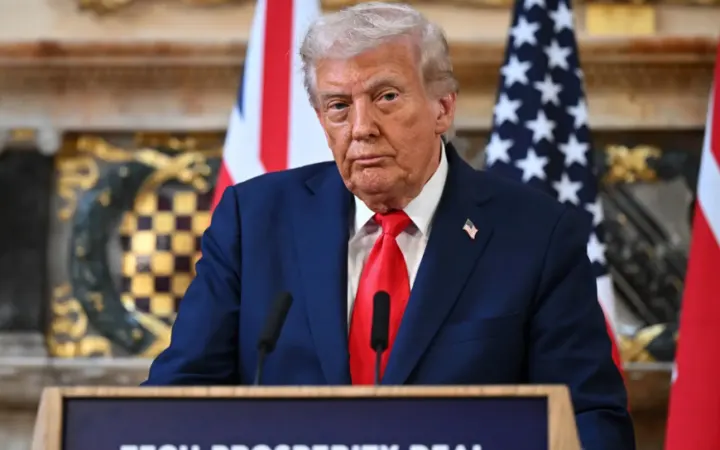
President Donald Trump said on Truth Social that he will sign an executive order requiring voter ID for “every single vote” and ending most mail-in voting. Supporters call it an election security step, while voting rights groups and legal experts say the Constitution leaves election rules to the states and Congress, setting up likely court challenges.
President Donald Trump said late Saturday, Aug. 30, that he plans to sign an executive order requiring voters to show identification and sharply limiting mail-in voting, reopening a long-running fight over how Americans cast their ballots.
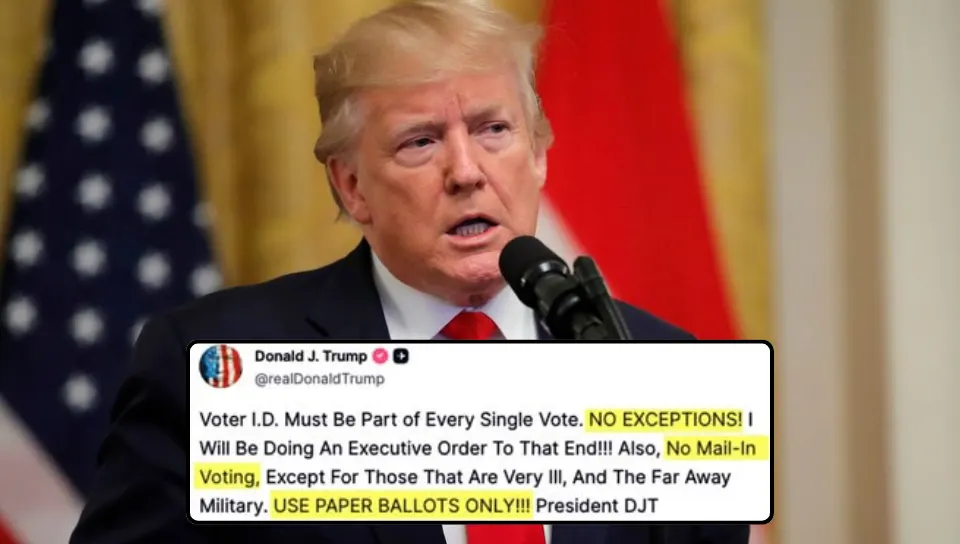
“Voter I.D. Must Be Part of Every Single Vote. NO EXCEPTIONS! I Will Be Doing An Executive Order To That End!!!” Trump wrote on Truth Social. In the same post he added: “Also, No Mail-In Voting, Except For Those That Are Very Ill, And The Far Away Military. USE PAPER BALLOTS ONLY!”
The White House did not immediately release the text of any order, and it was not clear when one would be signed or how it would be enforced.
What the president is proposing
Based on his post, the plan has two parts. The first is a nationwide requirement that voters show identification before casting a ballot. Today, rules vary widely by state: some require a photo ID at the polls, some accept other documents, and some do not require ID for most voters.
The second part would end most mail-in voting, with exceptions for people who are seriously ill and for military voters stationed far from home. Mail voting expanded sharply during the COVID-19 pandemic, and several states now conduct elections almost entirely by mail.
Trump has long argued that mail-in ballots invite fraud. Earlier in August he said he would lead a movement to get rid of mail-in ballots. Supporters of stricter rules say ID requirements and in-person voting make elections more secure and increase public confidence in results.
Why critics object
Democrats and voting rights organizations say the proposal would make it harder for millions of eligible Americans to vote. They point to studies showing that in-person voter impersonation, the type of fraud a photo ID requirement is meant to stop, is extremely rare.
Opponents argue that strict ID rules fall hardest on voters who are less likely to hold a current government-issued photo ID, including some elderly, low-income, rural and young voters. They also say ending mail voting would burden older voters, people with disabilities, and workers who cannot easily get to a polling place on Election Day.
Voting rights groups have said they would challenge new federal voting restrictions in court.
The constitutional question
The biggest obstacle may be legal. The Constitution’s Elections Clause gives states the power to set the “Times, Places and Manner” of holding elections for Congress, while allowing Congress to “make or alter such Regulations.” It gives the president no direct role in setting election rules.
Trump has already run into that limit this year. In March he signed an executive order on elections that included a requirement for documentary proof of citizenship to register. In April, U.S. District Judge Colleen Kollar-Kotelly blocked that part of the order, ruling that the Constitution assigns control of election regulations to Congress and the states. She wrote that the president cannot “short-circuit Congress’s deliberative process by executive order.”
Legal experts say a new order on voter ID and mail ballots would likely face similar challenges. A lasting national change would most likely require legislation passed by Congress, where Republicans hold narrow majorities and where Senate rules generally require 60 votes to advance major bills.
Where states stand
Because states run elections, their response will matter. Many Republican-led states already have strict photo ID laws and some have tightened mail voting rules. Other states, including several that vote almost entirely by mail, are likely to resist any federal attempt to change their systems.
Election officials in both parties have also noted that changing voting methods close to an election can create confusion for voters and poll workers, and that new equipment, ballots and procedures take time and money to put in place.
Public opinion
Voter ID itself is popular. A Gallup poll taken before the 2024 election found that 84% of U.S. adults favored requiring photo identification to vote. Views on mail-in voting are more divided along party lines, with Democrats much more likely than Republicans to support it.
What comes next
If Trump signs an order, lawsuits from states, voting rights groups or both are widely expected, and the courts would likely decide how much of it can take effect. In the meantime, the debate is likely to shape campaigns ahead of the 2026 midterm elections, with Republicans framing the issue as election integrity and Democrats framing it as access to the ballot.
Source: WJLA