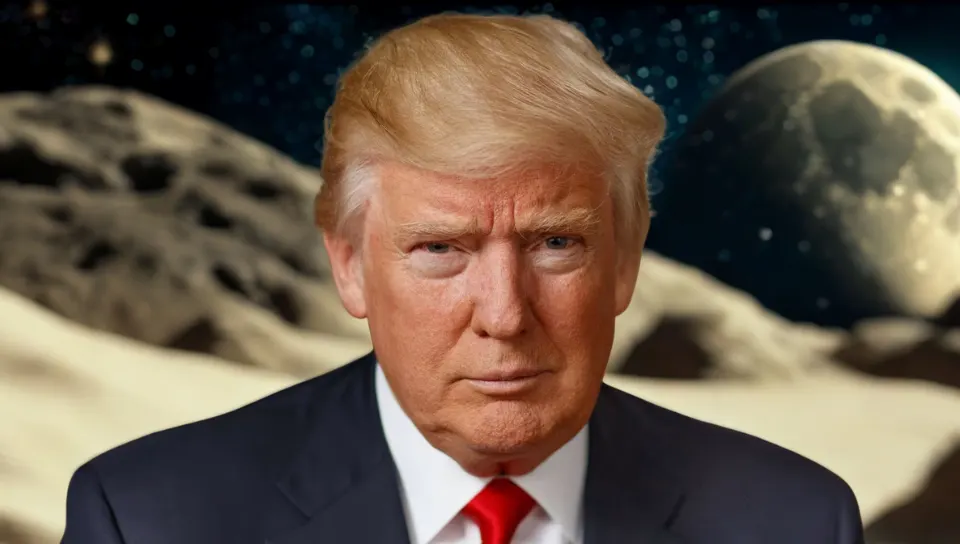
Acting NASA Administrator Sean Duffy said the United States aims to land astronauts on the Moon before President Trump’s term ends in January 2029, framing competition with China as a national priority. He told Fox News that America must win what he called “the second space race.”
Acting NASA Administrator Sean Duffy said the United States will aim to return astronauts to the Moon before the end of President Donald Trump’s term in January 2029. In an interview with Fox News, Duffy, who is also Transportation Secretary, presented the goal as a matter of national competitiveness and said America must win “the second space race” against China.
The timeline would turn NASA’s Artemis program, which has faced repeated delays, into a race against a fixed political deadline. Supporters say a clear goal can speed progress, while skeptics question whether the hardware will be ready in time.
Politics and the presidency
Tying a lunar landing to the end of Trump’s term links a major national goal to the administration’s record. Trump named Duffy, a former Republican congressman from Wisconsin, as acting NASA administrator in July 2025. Supporters say the deadline gives NASA a clear target, while critics argue that political timelines can put pressure on engineers to move faster than safety allows.
China’s lunar program
China’s space program has made steady progress. Its Chang’e 4 mission landed on the far side of the Moon in 2019, a first, and Chang’e 5 returned lunar samples to Earth in 2020, the first such mission since 1976. China is developing new heavy-lift rockets and has said it aims to land astronauts on the Moon by 2030. It is also working with Russia on a planned International Lunar Research Station near the Moon’s south pole, a separate effort from the U.S.-led Artemis Accords.
Can the deadline be met?
Key Artemis hardware is still being prepared. NASA’s Space Launch System rocket has flown once, on the uncrewed Artemis I mission in 2022. The Orion capsule has not yet carried a crew. SpaceX is developing a lunar version of its Starship vehicle as the Human Landing System, but Starship has not yet demonstrated the in-orbit refueling or lunar landing the mission requires. Many space industry observers have said the timeline leaves little room for setbacks.
Why the Moon matters strategically
Both the U.S. and China are targeting the lunar south pole, where scientists believe there are deposits of water ice. Ice could be used for drinking water, oxygen and rocket propellant, making it valuable for long-term exploration. The Artemis Accords, signed by dozens of countries, set out principles for peaceful and transparent lunar activity. U.S. officials have expressed concern that rival nations could try to restrict access to resource-rich areas.
Echoes of Apollo
The idea of a “space race” recalls the 1960s. In a 1962 speech at Rice University, President John F. Kennedy said the nation chose to go to the Moon “not because it is easy, but because they are hard.” Supporters of the new push hope it can build similar national purpose, while critics say the money could be better spent on problems at home.
The role of private industry
Unlike Apollo, Artemis relies heavily on commercial partners. SpaceX holds the first lunar lander contract, and Blue Origin was awarded a second lander contract in 2023 for its Blue Moon vehicle. A faster schedule would increase pressure on both companies, and NASA’s oversight of safety will be closely watched.
Reaction from partners and rivals
Artemis Accords partners such as Canada, Japan and European Space Agency members contribute hardware and astronauts to the program. They are likely to follow how a faster, more nationally framed U.S. timeline affects their roles. China has not changed its stated 2030 goal.
The budget question
Meeting a 2029 goal would require sustained funding from Congress. NASA’s Office of Inspector General has estimated that Artemis spending would reach about $93 billion through fiscal year 2025. Lawmakers from both parties will weigh the cost against other priorities, and Duffy’s experience in Congress may play a role in making NASA’s case.
What comes next
Duffy’s announcement sets an ambitious target. Whether it is met will depend on testing of SLS, Orion and the lunar landers, on funding decisions in Congress, and on how the next Artemis missions perform.
Source: Fox News