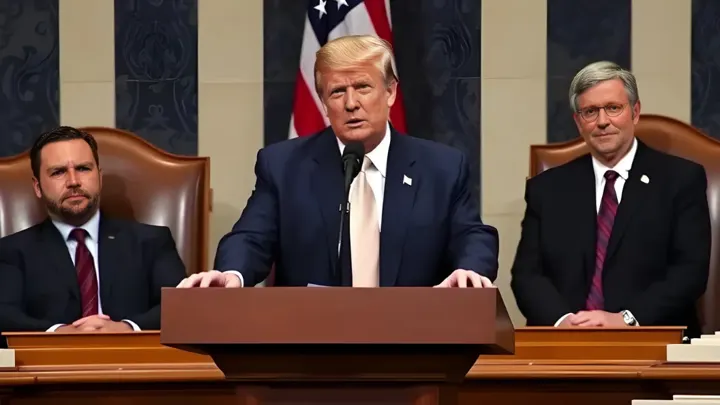
In his first address to a joint session of Congress of his second term, President Trump said his administration had accomplished more in its first 43 days than most administrations did in four or eight years. He outlined priorities on taxes, tariffs, immigration enforcement and government spending.
President Donald Trump delivered his first address to a joint session of Congress of his second term, highlighting what he described as an unprecedented start to his presidency. He outlined actions from his first six weeks in office and his plans on the economy, immigration enforcement and trade.
In a wide-ranging speech, Trump told lawmakers that his administration had accomplished more in its first 43 days than most administrations did in four or eight years, and he listed dozens of executive actions, policy reversals and proposed changes.
Among the actions he cited were a freeze on foreign aid, withdrawals from international agreements and organizations, a drop in illegal border crossings and regulatory rollbacks. Trump also highlighted his executive orders on diversity programs, transgender athletes in women’s sports and school policies.
“Wokeness is trouble. Wokeness is bad. It’s gone,” he said.
Political division in the chamber
Republican members frequently stood and applauded, while most Democrats remained seated. Several Democrats held small signs with messages such as “False” and “Save Medicaid.” Early in the speech, Rep. Al Green (D-Texas) stood and shouted at the president, objecting to possible cuts to Medicaid, and was removed from the chamber on the order of House Speaker Mike Johnson.
Trump repeatedly criticized former President Joe Biden, blaming the previous administration for inflation and other economic problems.
Economic policy and taxes
Trump promised relief for working families, blamed high prices on the previous administration and pledged to cut what he called government waste.
His economic proposals included:
- Eliminating taxes on tips, overtime and Social Security benefits.
- Continuing the work of the Department of Government Efficiency (DOGE) to cut spending.
- Imposing reciprocal tariffs on U.S. trading partners.
Trump acknowledged that his tariffs could cause some short-term disruption, including for farmers, but said they were necessary to protect American industry.
Trade and budget
Despite warnings from many economists that tariffs could raise prices, Trump said reciprocal tariffs on trading partners would take effect on April 2. New tariffs on goods from Canada and Mexico, and higher tariffs on Chinese goods, had taken effect the same day as the speech.
Trump also said he wanted to balance the federal budget, but gave few details on how he would do so while extending tax cuts, with the annual deficit running close to $2 trillion.
Foreign policy and Ukraine
Foreign policy received less attention. Trump repeated his interest in acquiring Greenland and in reasserting U.S. control over the Panama Canal.
On the war in Ukraine, Trump read from a letter he said he had received from Ukrainian President Volodymyr Zelensky. According to Trump, the letter said: “My team and I stand ready to work under President Trump’s strong leadership to get a peace that lasts.”
Legislative outlook
Trump closed by urging Congress to act on his priorities, including immigration enforcement and tax cuts. The speech lasted about an hour and 40 minutes, making it one of the longest presidential addresses to Congress in modern times.
The address underlined the sharp partisan divide in Washington and the administration’s plans to continue pursuing major changes to economic, social and foreign policy.
Source: NPR via WBUR