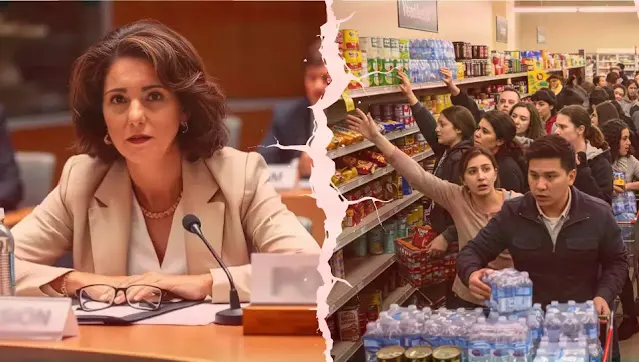
The European Union is urging its nearly 450 million residents to keep at least 72 hours of essential supplies, such as food and water, at home. The European Commission says the guidance is part of its first preparedness strategy, which responds to risks including war, cyberattacks, climate-related disasters and pandemics.
The European Union is calling on its nearly 450 million residents to prepare for potential crises by keeping at least 72 hours’ worth of essential supplies at home. The guidance, part of a strategy presented by the European Commission on Wednesday, March 26, 2025, reflects growing concern about instability and the risk of emergencies.
EU officials say it is part of a wider effort to strengthen resilience and preparedness across the bloc, as risks from war, cyberattacks, climate-related disasters and pandemics become more frequent and interconnected.
A shift in mindset for the EU
The European Commission’s new strategy urges EU countries and their citizens to prepare more seriously for emergencies. Hadja Lahbib, the European Commissioner for Equality, Preparedness and Crisis Management, said, “Today’s threats are fast, complex, and interconnected.”
In a video posted on X, Lahbib showed the contents of her own emergency bag, including food, water, a flashlight, ID papers, a phone charger, a Swiss Army knife, medicine and a radio. “Ready for anything – this must be our new European way of life,” she wrote.
The plan builds on lessons from past emergencies, including the COVID-19 pandemic, Russia’s war in Ukraine, and threats to Europe’s energy and information networks.
A growing list of risks
The Commission’s Preparedness Union Strategy, which sets out 30 actions and objectives, describes the risks facing Europe as more complex and interconnected than before.
It points to Russia’s full-scale invasion of Ukraine, rising geopolitical tensions and sabotage of critical infrastructure as major concerns, along with electronic warfare, disinformation campaigns and climate-related disasters.
The strategy follows a report led by former Finnish President Sauli Niinistö, now a special adviser to Commission President Ursula von der Leyen, which found the EU had “no clear plan on what to do in the event of armed aggression against a Member State.” Niinistö said the Union needed a change of mindset “in the face of a more dangerous world.”
School lessons and strategic stockpiles
The Commission also proposed adding preparedness lessons to school programs, including practical safety skills and lessons on recognizing disinformation and information manipulation. It suggested an EU-wide “Preparedness Day” and regular exercises bringing together armed forces, police, healthcare workers and firefighters.
The EU also plans to strengthen its strategic reserves of critical resources such as:
-
Firefighting aircraft
-
Medical equipment
-
Energy and transport supplies
-
Equipment to protect against chemical, biological, radiological and nuclear threats
Advertisement
These resources would be available for rapid deployment during major disasters or emergencies.
Learning from Northern Europe
Several EU countries already have well-developed civil protection systems. Finland, France and Sweden, for example, have long promoted household emergency preparedness.
In 2024, Sweden updated its Cold War-era preparedness brochure, giving households advice on how to respond to a range of threats, including war.
Germany also updated its civil defense planning in 2024. Its Framework Directive for Overall Defense outlines how the country would respond in the event of a military conflict in Europe. It was presented by then-Interior Minister Nancy Faeser amid concerns about Russian aggression.
A call to member states
“New realities require a new level of preparedness in Europe,” said European Commission President Ursula von der Leyen, adding that citizens, member states and businesses need “the right tools to act both to prevent crises” and to respond when they occur.
The Commission wants member states to coordinate better in emergencies, since not every country currently has the same level of readiness.
NATO and European defense
The EU’s push for civil preparedness comes as NATO Secretary-General Mark Rutte has urged European allies to work more closely together and increase their defense efforts, with the United States pressing Europe to take on more of the burden.
NATO, founded in 1949, has 32 member countries. The Trump administration has said Europe must take more responsibility for its own security.
These developments have prompted efforts across Europe to strengthen both military forces and civil defense systems and emergency response capabilities.
Household planning
Beyond physical supplies, the strategy emphasizes broader societal resilience, so that people are better able to cope during emergencies.
Common household preparedness advice includes steps such as:
-
Making emergency contact lists
-
Keeping a battery-powered radio
-
Knowing where to go during evacuations
The EU is not predicting an imminent crisis, but the strategy says Europe faces an increasingly unpredictable security environment.
Growing emphasis on civil defense
The EU’s guidance echoes long-standing advice from civil protection agencies elsewhere. Many countries, including the United States, recommend that households keep basic emergency kits and family plans.
By asking residents to prepare for at least 72 hours, the EU is focusing on the early period after a disaster, when services may be disrupted and help could take time to arrive.
The strategy is part of the Commission’s broader effort to make Europe better able to withstand crises without major breakdowns in public services, supply chains or social stability.
A coordinated response
As the EU works to improve emergency coordination across its 27 member states, officials say success will depend on how well countries share resources, communicate and plan together.
By building shared reserves and investing in early planning, the Commission aims to help the bloc anticipate crises rather than only react to them.
Source: ITV News