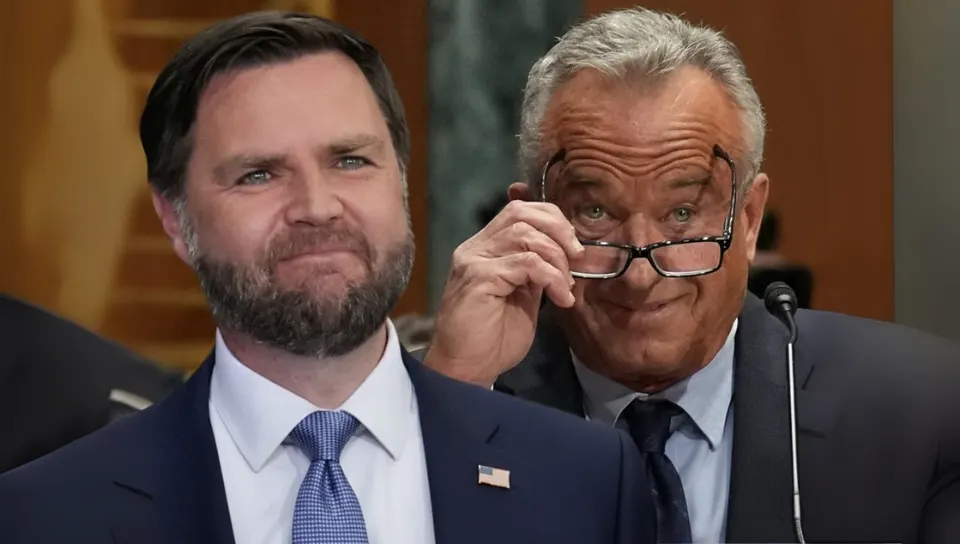
Vice President JD Vance attacks Democrats in a profanity-laced social media post after Senate Democrats grilled Health and Human Services Secretary Robert F. Kennedy Jr. for hours. At the Senate Finance Committee hearing, Democrats called for Kennedy’s resignation and labeled him a charlatan.
Washington D.C. was the scene of a political inferno on Thursday as Health and Human Services Secretary Robert F. Kennedy Jr. faced a blistering multi-hour grilling from Senate Democrats over his controversial leadership. But the fireworks in the Senate Finance Committee room were arguably eclipsed by the explosion that followed on social media. In an extraordinary move, Vice President J.D. Vance launched a profanity-laced tirade against the Democratic senators, defending Kennedy and accusing them of staggering hypocrisy in a post that instantly went viral. The hearing, which saw Democrats call for Kennedy’s resignation and label him a “charlatan” and a “hazard to the health of the American people,” was intended to scrutinize the turmoil at the CDC and the secretary’s well-known skepticism of vaccine science. Instead, it became a flashpoint in the nation’s roiling culture wars, culminating in Vance’s bombshell defense that reframed the entire debate. He alleged that the very senators attacking Kennedy over child safety are the ones promoting “irreversible” medical treatments for minors, creating a stunning and volatile new front in the battle over American healthcare and who can be trusted to protect its children.
A Senate hearing turns into a political brawl.
Can you handle the heat from this explosive opening salvo?
The Hearing: Kennedy in the Crosshairs
The stage for this political drama was set from the moment the hearing was gaveled into session. Ostensibly about the Trump administration’s “Make America Healthy Again” agenda, the proceedings quickly transformed into a direct assault on Secretary Kennedy’s tenure. Senator Ron Wyden of Oregon, the committee’s ranking Democrat, set the tone in his opening remarks, foregoing pleasantries to demand Kennedy be formally sworn in, citing the secretary’s alleged history of dishonesty. “Robert Kennedy’s primary interest is taking vaccines away from Americans,” Wyden declared. “People are hurt by his reckless disregard for science and the truth.” Throughout the combative three-hour session, a parade of Democratic senators took turns hammering Kennedy. They questioned him on the recent mass firings and resignations at the Centers for Disease Control and Prevention (CDC), his decision to replace a key vaccine advisory board with known skeptics, and his past statements calling the COVID-19 shot the “deadliest vaccine ever manufactured.” Senator Raphael Warnock of Georgia called Kennedy a “hazard to the health of the American people,” while Senator Maria Cantwell of Washington was even more blunt, telling him, “Sir, you’re a charlatan.” Kennedy, for his part, was defiant and combative. He returned fire, accusing senators of “talking gibberish,” “making stuff up,” and failing to understand basic science. He defended the CDC shake-up as “absolutely necessary” to purge officials responsible for failed COVID-19 policies like school closures and mask mandates. He claimed his goal was to restore faith in public health by championing “unbiased, politics-free, transparent, evidence-based science,” free from the influence of “Big Pharma.”
Accusations of lies and charlatanism flew across the room.
Can you recall the key attacks and defenses from the fiery hearing?
Vance’s Counter-Offensive: “You’re Full of S—“
As the hearing concluded, the battle shifted from the committee room to the digital town square, and Vice President J.D. Vance entered the fray with a rhetorical sledgehammer. In a post on X that quickly garnered millions of views, Vance unloaded on the Democratic senators who had just spent hours attacking Kennedy. “When I see all these senators trying to lecture and ‘gotcha’ Bobby Kennedy today all I can think is: You all support off-label, untested, and irreversible hormonal ‘therapies’ for children, mutilating our kids and enriching big pharma,” Vance wrote. He concluded with a stunningly blunt and profane sign-off: “You’re full of s— and everyone knows it.” The post was a political masterstroke of jujitsu. Vance took the Democrats’ central charge against Kennedy, that he was endangering children, and turned it directly back on them. He pivoted the entire conversation from Kennedy’s record on vaccines to the Democrats’ platform on gender-affirming care for minors, a deeply polarizing issue. By accusing them of supporting the “mutilation” of children, he used language far more inflammatory than anything said in the hearing. Furthermore, he co-opted Kennedy’s own line of attack by accusing the Democrats of being the ones truly “enriching big pharma” through their support for hormonal therapies, thereby framing them as the hypocritical pawns of corporate interests. Kennedy himself quickly reposted Vance’s message, thanking him for the support and amplifying the counter-narrative to his millions of followers.
Vance Attacks Democrats as the Battle Moves to Social Media
Can you dissect VP Vance’s explosive, profanity-laced post?
Turmoil at the Top: The CDC Shake-Up Explained
The intense scrutiny of Secretary Kennedy did not emerge from a vacuum. It is the direct result of a period of unprecedented chaos at the nation’s top public health agency. The catalyst was Kennedy’s abrupt firing of CDC Director Susan Monarez last week, less than a month after she had been confirmed by the Senate. Monarez, an appointee of President Trump who was initially endorsed by Kennedy himself, was ousted in a move that sent shockwaves through the public health community. Her dismissal prompted several other top CDC leaders to resign in protest, leaving the agency in a state of leadership crisis. The day of the hearing, the situation escalated further when Monarez published a scathing op-ed in The Wall Street Journal. In it, she claimed she was fired for refusing a direct order from Kennedy to “preapprove” the recommendations of a newly reconstituted vaccine advisory panel. She alleged that Kennedy had stacked this influential committee with individuals known for their “antivaccine rhetoric.” In the hearing, Kennedy vehemently denied Monarez’s account. He called her claims “lies” and asserted that he had fired her only after she admitted to him that she was not a “trustworthy person.” He later acknowledged that he had, in fact, ordered Monarez to fire several career scientists at the agency. This public he-said, she-said between a sitting cabinet secretary and his recently fired, Senate-confirmed agency head has created an atmosphere of deep distrust and has become the central exhibit for Democrats arguing that Kennedy’s leadership is dangerously erratic.
A public health agency is in chaos.
Can you separate fact from accusation in the CDC leadership crisis?
“Over the Target”: The White House Circles the Wagons
While Vice President Vance’s defense was the most explosive, he was not the only administration official to rush to Secretary Kennedy’s side. The White House launched a coordinated messaging campaign to bolster their embattled cabinet member and paint the Democratic attacks as politically motivated. White House Press Secretary Karoline Leavitt declared that Kennedy was “taking flak because he’s over the target.” This line of argument portrays Kennedy not as a purveyor of conspiracy theories, but as a courageous truth-teller who is threatening a corrupt and failed establishment. “The administration is addressing root causes of chronic disease, embracing transparency in government, and championing gold-standard science,” Leavitt said. “Only the Democrats could attack that commonsense effort.” Deputy Chief of Staff Taylor Budowich echoed this sentiment, calling the Democratic senators “parrots of a failed medical orthodoxy.” This strategy aims to discredit the critics by casting them as defenders of a broken status quo that has seen rates of chronic disease skyrocket in America. It’s a narrative that resonates deeply with the administration’s populist base, which is inherently skeptical of established institutions, be they in government, media, or science. By framing the conflict in this way, the White House is not just defending a single cabinet secretary; it is reinforcing its core message that it is fighting on behalf of ordinary people against a powerful and self-serving elite. Kennedy’s ordeal, in this telling, is a proxy battle for the soul of American science itself.
The White House says the attacks prove he’s doing something right.
Do you understand the official narrative defending RFK Jr.?
Not Just Democrats: Bipartisan Concerns Emerge
While the most vitriolic attacks on Secretary Kennedy came from the Democratic side of the aisle, the hearing revealed that discomfort with his leadership is a bipartisan affair. Several Republican senators, while avoiding the harsh language of their colleagues, expressed serious concerns about the direction of the nation’s health agencies. Senator Bill Cassidy of Louisiana, a physician who has consistently supported vaccination, pressed Kennedy on the confusion his policies were creating. He concluded by telling the secretary that his actions were “effectively denying people the vaccine.” Senator John Barrasso of Wyoming, also a physician, reminded Kennedy of his confirmation hearing promise to uphold the highest standards for vaccines, adding, “Since then, I’ve grown deeply concerned.” North Carolina Senator Thom Tillis also indicated he wanted to hear from Kennedy in person to address his reservations. This Republican skepticism is significant because it demonstrates that the opposition to Kennedy is not based solely on partisan politics. It stems from genuine concern within the traditional medical and pro-science wings of the Republican party that the new leadership at HHS is undermining decades of established public health consensus. These senators find themselves in a difficult position, caught between their traditional support for a Republican administration and their alarm at policies they believe could endanger public health by fueling vaccine hesitancy and creating chaos within the institutions designed to protect the nation.
The concerns are coming from both sides of the aisle.
Why are Republican doctors in the Senate worried about RFK Jr.?
The Letter: A Plea from Within
Adding another layer of pressure to the already intense situation, the Senate hearing took place just one day after a bombshell letter, signed by over 1,000 current and former employees of the Department of Health and Human Services, was made public. This unprecedented document amounted to an open rebellion from within the secretary’s own department, calling for his immediate resignation. The letter represents the voice of the scientific and administrative backbone of the nation’s public health infrastructure, expressing deep alarm at the direction Kennedy is taking the agency. The signatories, who include scientists, doctors, and career civil servants, argue that Kennedy’s leadership is actively harming the department’s mission and credibility. They cite his public questioning of vaccine safety, his embrace of what they consider conspiracy theories, and the chaotic ousting of the CDC’s leadership as actions that erode public trust in science and jeopardize the health of millions. This internal revolt provides critical context for the Democratic senators’ attacks; they are not just voicing their own opinions, but are amplifying the desperate pleas of the very experts who work within the agencies Kennedy oversees. The existence of this letter makes it much harder for the White House to dismiss the criticism as purely partisan, as it demonstrates a profound crisis of confidence among the non-partisan professionals tasked with protecting America’s health.
Over 1,000 HHS employees have spoken out.
Do you understand the significance of this internal rebellion?
The Stakes: A Nation’s Health on the Line
Beyond the political theater and angry accusations, the clash between Secretary Kennedy and his critics has profound real-world consequences. The ongoing turmoil at the CDC and the public questioning of vaccine efficacy come at a perilous time. Public health experts warn that this could fuel a resurgence of preventable diseases like measles and mumps, just as children are heading back to school. Conflicting messages from the nation’s top health officials create confusion for parents trying to make informed decisions and can embolden anti-vaccine movements. A drop in routine childhood immunizations could quickly lead to outbreaks that threaten the most vulnerable. At the same time, the intense politicization of health agencies can lead to a brain drain, as talented and dedicated scientists may choose to leave public service rather than endure the constant political battles. This erodes the nation’s ability to respond to the next public health crisis, whether it be a new pandemic, a natural disaster, or a bioterrorism event. The fight in Washington is not an abstract debate; it has a direct impact on the health and safety of every American family. The erosion of trust in institutions like the CDC is a slow-burning crisis that could take decades to repair, leaving the nation more vulnerable and less prepared for the challenges to come.
School is back in session, and diseases could be too.
What are the real-world consequences of this political battle?
This isn’t just politics; it’s about your family’s health. Do you understand the stakes?
A Tale of Two ‘Crises’: Vaccines vs. Gender-Affirming Care
Vice President Vance’s explosive intervention has masterfully linked two of the most contentious issues in American public life: vaccine policy and transgender healthcare for minors. His accusation of hypocrisy rests on the premise that both issues are fundamentally about the well-being of children and the influence of pharmaceutical companies. From his perspective, Democrats are ignoring potential risks associated with vaccines while simultaneously championing hormonal therapies that he and other conservatives view as experimental and dangerous. He sees a double standard where one set of medical interventions is scrutinized with extreme skepticism, while another is accepted with what he considers insufficient critical examination. Democrats and medical experts on their side of the issue reject this comparison entirely. They argue that there is a broad and long-standing scientific consensus on the safety and efficacy of routine childhood vaccines, whereas gender-affirming care is a newer field of medicine. However, they maintain that this care is also evidence-based, endorsed by every major medical association, and often life-saving for transgender youth who face high rates of suicide. They accuse Vance of creating a false equivalency, deliberately misrepresenting gender-affirming care as “mutilation” to score political points and distract from the scientifically unsupported views of Secretary Kennedy. This strategic linking of the two issues ensures that the debate is no longer just about RFK Jr.’s fitness for office; it is now a full-blown cultural conflict over which party is the true protector of children’s health.
Two medical debates have now become one political war.
Can you weigh the arguments in this complex comparison?
Conclusion: Public Health is the New Political Battlefield
The fiery Senate hearing and Vice President Vance’s subsequent profane defense have laid bare a stark reality: public health in America is now a full-contact political sport. The days of deferring to scientific consensus and non-partisan expertise on issues like vaccination are over, replaced by a brutal war of narratives where accusations of “mutilation” and “charlatanism” are commonplace. The clash over Secretary Robert F. Kennedy Jr.’s leadership is about far more than one man; it is a battle for the very definition of scientific truth and the control of the institutions that shape the health of the nation. The White House and its allies see a captured, corrupt system in desperate need of a populist overhaul, while Democrats and the scientific establishment see a dangerous assault on evidence-based medicine that puts millions of lives at risk. With the Vice President leading the charge, linking vaccine skepticism to the transgender culture war, the administration has escalated the conflict to a new level of intensity. There is no middle ground in this fight, and the ultimate casualty may be the very public trust that is essential for a functioning public health system. As the political rhetoric grows more heated, American families are left to navigate a confusing and toxic landscape, with the health of their children hanging in the balance.